
Wedding Bells, Death Knells
spoilers ahead
In Plato’s Symposium (c.385-370 B.C), playwright Aristophanes introduces the Greek myth of soulmates. It is said that humans were once born with two faces, four arms, and four legs. To minimize their power, Zeus split them in two, condemning humans to an eternal search for their “other half.” In a world populated by 8 billion people, are we truly meant to believe that we will find and marry our supposed soulmate? And if we do, would we be willing to put that love to the test if the stakes were life or death? Haley Z. Boston’s Something Very Bad is Going To Happen (2026) poses these daunting questions.
The Duffer Brothers’ comeback series opens on an ominous wedding montage, which we can interpret as Rachel’s lifelong premonition, the source of her paranoia and unease surrounding the upcoming weekend. We are then introduced to the seemingly cute and happy couple, Rachel and Nicky. They quickly establish the duo’s black cat/golden retriever dynamic. Camila Morrone’s Rachel Harkin is dark, mysterious, and guarded, whereas Adam DiMarco’s Nicky Cunningham is caring, attentive, and sensitive.
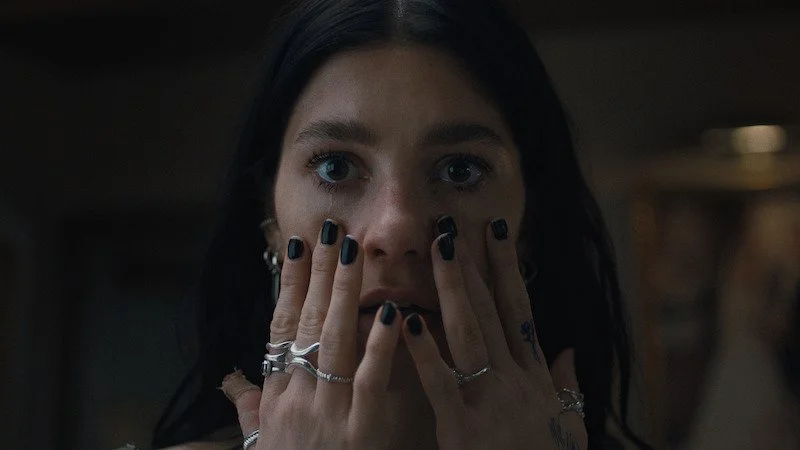
Camila Morrone in Something Very Bad is Going to Happen
The series is reminiscent of Mike Flanagan’s The Haunting of Hill House (2018), particularly in its use of curses and childhood monsters. Victoria Pedretti, who played Nell in Hill House, stuns in her brief appearance as Rachel’s mother, Alexandra Harkin. Their shared intuition forges a clear mother-daughter connection. They also share their taste in men, each falling for their respective “nice guy.” While Nicky and Jay initially seem sweet and harmless, the series serves as a cautionary tale about this archetype. These men lie, not through overt cruelty, but by telling their romantic partners exactly what they want to hear. In both cases, this deceitfulness proves fatal.
DiMarco excels at embodying the innocent, sheltered, yet ultimately selfish Nicky, who becomes increasingly detestable by the end. The actor particularly shines in the final episodes, where the character’s true colours are exposed. In just a few scenes, the audience’s perception of Nicky shifts completely as his web of lies unravels. His most endearing traits reveal themselves to be performative. The understanding, patient man we were introduced to gives way to a cowering, immature boy.
Morrone, meanwhile, delivers a nuanced portrayal of Rachel’s complex mental state. The character’s baseline emotion is dread, and we see hints of it come out even in her most hopeful moments. This is most evident on her wedding day, as Rachel frantically attempts to perform a love spell that transforms her into Nicky’s ideal partner. Throughout these stressful scenes, Morrone’s character appears determined and hopeful, yet the unease lingers in the background.
The Cunningham family adds another layer of discomfort through their hauntingly memorable performances. Gus Birney’s Portia evokes that feeling of the uncanny. The spoiled and petulant sister character is familiar but Birney finds a way to make her feel foreign and menacing. Portia is at once hollow and overfull, an artificial figure brimming with secrecy.
Jeff Wilbusch plays Jules Cunningham, Nicky’s older brother. While he initially comes across as cold and patronizing, Jules gradually reveals himself to be a more layered, well-rounded character. His relationship with his wife Nell exposes the hardest part of love: honesty. While being truthful with your partner may lead to a healthy relationship, it also invites you to see the ugliest parts of someone. This kind of romance is rarely depicted on screen, making their dynamic especially compelling. Nell and Jules’ shared wit and their uneasy rapport also made them strangely enchanting. We are never quite sure whether they love each other, hate each other, or both. When it is later shown that Jules is one of the only family members who married his true soulmate, it feels unexpectedly rewarding.
I suspect that my own response to the show is shaped by a longstanding preoccupation with love and marriage. In a society where divorce is normalized, or even expected, I find myself overthinking marriage and relationships as though I, too, were living with Rachel’s curse.
The Haunting of Hill House is unfortunately a tough to show to be compared to. With its stellar cast, intricate narrative, and emotionally rich characters, it set a high bar for the genre. Each character was fighting their own demons. Each storyline felt real. By comparison, Something Very Bad is Going To Happen feels a little more singular in focus. While many of its characters were intriguing, there simply wasn’t enough time for us to care about anyone but Rachel.
Still, even though SVBIGH didn’t reach the emotional depth of Hill House, it still succeeds in embedding a persistent, unsettling question in the viewer’s mind:
are you sure (s)he’s the one?